Tiki Central / General Tiki / Unpopular Tiki Opinions
Post #818151 by HotelCharlie on Thu, Mar 26, 2026 8:31 PM
|
H

HotelCharlie
Posted
posted
on
Thu, Mar 26, 2026 8:31 PM
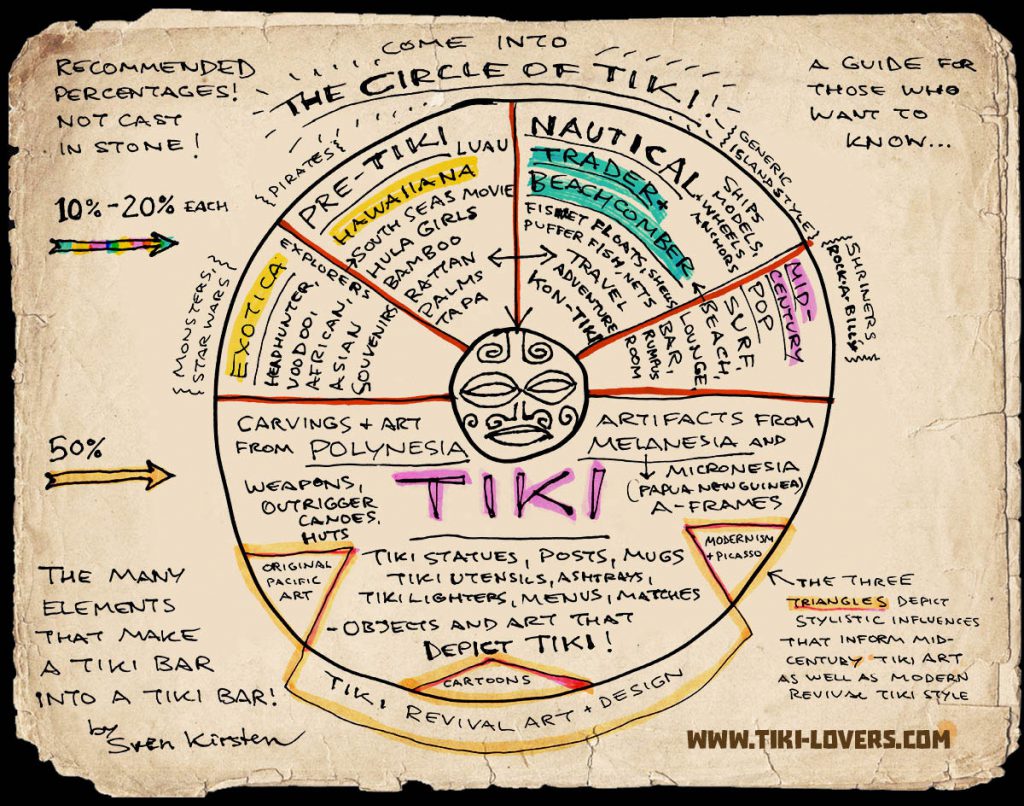
The tradition started by Don the Beachcomber lost something by focusing almost entirely on Polynesian influences to the exclusion of others. I think our concept of “Tiki” is not only narrower and less interesting than escapism/adventure-themed bars/“exotica” generally, but also would have meant little to the originator of the form, Donn Beach himself. As more of a “pre-Tiki” or “adventure” bar, DtB’s seems to have had a broader palette that embraced other exoticisms beyond the South Seas, and in our obsession with keeping Tiki more authentically Polynesian (or more accurately, authentically faux Polynesian) I think we miss out on a fun and valuable element of the original. In that regard, I have often found it interesting that Tiki so readily embraced one Western strain of Oriental exoticism (Chinoiserie) but more or less rejected another (Turquerie). For those who may be unfamiliar, Chinoiserie refers generally to exoticism focused on the Far East (https://en.m.wikipedia.org/wiki/Chinoiserie), whereas Turquerie refers generally to exoticism focused on North Africa, the Middle East and parts of South Asia (https://en.m.wikipedia.org/wiki/Turquerie). Although the terms usually refer to historical exoticisms, interest in those cultures and incorporation of stylistic elements therefrom into music, art, architecture, food and drink obviously continues to today. As is pretty well known, Tiki embraced - and was embraced by - Chinoiserie from the beginning, with Chinese restaurants and tiki bars readily swapping elements back and forth. I think the recently-closed Kapu in Petaluma, CA (https://www.kapubar.com/; https://tikicentral.com/viewtopic.php?topic_id=53964) was a good recent example of a Tiki bar embracing the Far East, whereas Kowloon in Saugus, MA (https://www.kowloonrestaurant.com/; https://tikicentral.com/viewtopic.php?topic_id=10145) is a much older example of (I think?) the opposite - primarily a Chinese restaurant that embraced Tiki. This connection seems to be even older than Tiki itself, with the OG Hollywood Don the Beachcomber famously serving Cantonese food (https://scholarsarchive.jwu.edu/cgi/viewcontent.cgi?article=1031&context=restaurant_menus). An exhaustive list of examples would run several pages. But Chinoiserie was not the only Eastern exoticism that has historically captured the Western imagination. The Turquerie tradition that was popular earlier in Europe certainly had some influence in U.S. architecture, art and design, but that tradition (with a few exceptions) does not seem to have enjoyed as much popularity, let alone staying power, as Chinoiserie when it comes to themed drinking and dining. And maybe that’s intuitive when it comes to Tiki - China/Japan/etc. sit on the western edge of the ocean that is home to Polynesia, and are closer geographically, so maybe those influences “fit” better with the Tiki aesthetic than influences from the desert cultures of South/Southwest Asia and Northern Africa. But it still seems a bit odd to me, especially since Tiki’s ground zero - Don the Beachcomber’s - seemed to welcome Turkish/Ottoman influences. For example, the selection of daggers for Don’s Dagger Bar in Waikiki included several Middle Eastern/North African specimens (https://thumbs.worthpoint.com/zoom/images4/1/0614/04/vintage-don-beachcombers-dagger-bar_1_af1326d2c2f09e2b86d913622f5eca88.jpg). DtB’s also famously invented the Cobra’s Fang (no cobras in Polynesia, but they occupy a noteworthy role in the Western imagination when it comes to North Africa, the Middle East and India), and several DtB menus included the Rangoon Gimlet (touted on his “Drinks from Hot Countries” menu as “Famous in India”). But it wasn’t just DtB that welcomed the influence of Turquerie - the Exotica musical genre embraced those kinds of influences from the very beginning (see Kostelanetz’s Lotus Land, Kashmiri Song, and Song of India, or Raymond Scott’s Twilight in Turkey, At an Arabian House Party, and Egyptian Barn Dance, or pretty much all of Korla Pandit, etc.). The point being, it’s not like these influences weren’t there in early/pre-Tiki “culture”. (Side note: maybe there is a thread connecting these early DtB Turkish influences with the later decision to locate the Las Vegas DtB location in The Sahara?) Of course, DtB’s own predecessors in the “exotic dining” tradition were also known to include examples of both Chinoiserie and Turquerie. See, e.g., the Cocoanut Grove at LA’s Ambassador Hotel, which famously included in its decor “Moorish arches” and items salvaged from 1921’s The Sheik: https://en.wikipedia.org/wiki/Cocoanut_Grove_(Ambassador_Hotel). And this feels like as good a place as any to reference the Tiki-adjacent icon that is the Waikiki Royal Hawaiian hotel, opened in 1927 and renowned for its Moorish-style architecture (https://en.m.wikipedia.org/wiki/Royal_Hawaiian_Hotel). Nevertheless, over time the Tiki tradition seems to have moved staunchly away from Turquerie while continuing to allow space for Chinoiserie. There have, it should be noted, been themed non-Tiki bars and restaurants that embraced Turquerie. An older, more obscure example that comes to mind - for which there is also a Tiki connection - was the Garden of Allah in Seal Beach, California (https://sbfoundersday.wordpress.com/2019/09/09/tdisbh252/). The restaurant presumably got its name from the 1904 novel by Robert S. Hichens and/or its film treatments over the years (https://en.m.wikipedia.org/wiki/The_Garden_of_Allah_(novel)), which also likely inspired the more famous 1920s Hollywood hotel of the same name (https://en.m.wikipedia.org/wiki/Garden_of_Allah_Hotel). The Tiki connection is that the Garden of Allah in Seal Beach was owned by Vivian Laird, who also owned the South Seas in Anaheim (https://tikicentral.com/viewtopic.php?topic_id=40145). The Seal Beach restaurant seems to have opened in 1936 (https://www.newspapers.com/article/independent-vivian-lairds-restaurant/56919593/ ) and was sold in the late 1950s (https://sbfoundersday.wordpress.com/2019/01/04/tdisbh004/). A more lasting example of the influence in hotel/resort form is the aforementioned Sahara Las Vegas, opened in 1952 and still in operation more than 70 years later (https://en.m.wikipedia.org/wiki/Sahara_Las_Vegas). I would argue that another, much more up to date/modernized example, is The Green Zone in Washington D.C.’s Adams Morgan neighborhood (https://www.thegreenzonedc.com/). I went there a while back with HotelCharlie Jr. and was really impressed with everything about it: great cocktails, very good food and a fun, unique, and yes - something akin to “Tiki” - vibe. Even came home inspired to make my own version of an Arabian bitters, which I have really enjoyed. For those who aren’t familiar, the Green Zone theme is the International Zone in Baghdad in the post-9/11 era. The menu includes some really good “Middle Eastern” spins on classic and original cocktails, and the food is good and well matched for the cocktail theme and focus. The decor doesn’t have Tiki’s “over the top-ness”, but it’s perfect for the theme and still has plenty of fun eye candy (including the rows of Johnny Walker Black everywhere you look, a hilarious nod to that spirit’s ubiquity in the modern urban Arab world). And I suspect the Tiki-ish vibe is by design, since the menu includes not only several Tiki-inspired originals (such as their riffs on the Hurricane and Jungle Bird), but also several straight up Tiki standards (Zombie, Mai Tai, Queen’s Park Swizzle, etc.). Any other thoughts on the subject? Do you agree that the incorporation of Chinoiserie and rejection of Turquerie is more natural as Tiki evolved toward Pacific-adjacent influences? Or should drinking and dining establishments influenced by Middle Eastern exoticism be themselves considered Tiki-adjacent? Any other famous examples that deserve a mention? Are fezzes (https://tikicentral.com/viewtopic.php?topic_id=19526) possibly an example of the style that crept into Tiki to stay? Where does the Tiki-ish Blood and Sand cocktail fit in this discussion? And how does this style compare to African exoticism, which seems to sit somewhere between Chinoiserie and Turquerie in its influence on Tiki - there to be observed when we look back (see Bigbro’s Wheel of Tiki at 9 o’clock: https://www.tiki-lovers.com/wp-content/uploads/2019/05/the-circle-of-tiki_map-by-Sven-Kirsten_19-05-1024x806.jpg), but - if we’re being intellectually honest - squarely outside the Polynesian pop vibe. |